Grow Herb Cuttings with Confidence: Four Small Experiments to Learn Propagation
Propagation is a hands-on skill best learned by small, controlled trials. The following set of four short experiments helps you learn how different herbs, media, and treatments affect rooting. Each experiment isolates one variable so you can build confidence and reproducibility for propagating herbs from cuttings.
Before you start: general materials and baseline method
Common supplies for all experiments: clean scissors or pruning shears, small clear containers or a seed tray, a way to label samples, a spray bottle, and a bright spot with indirect light. Choose easy test subjects: basil, mint, and lemon balm are forgiving; rosemary and sage are slower and better later in the learning sequence. Use similar-sized cuttings for fair comparisons: 3–4″ (7–10cm) of healthy, non-flowering stem, stripped of lower leaves.
Experiment 1 — Water vs. Soil (objective: compare rooting speed and handling)
Method
- Take six matched cuttings from the same plant.
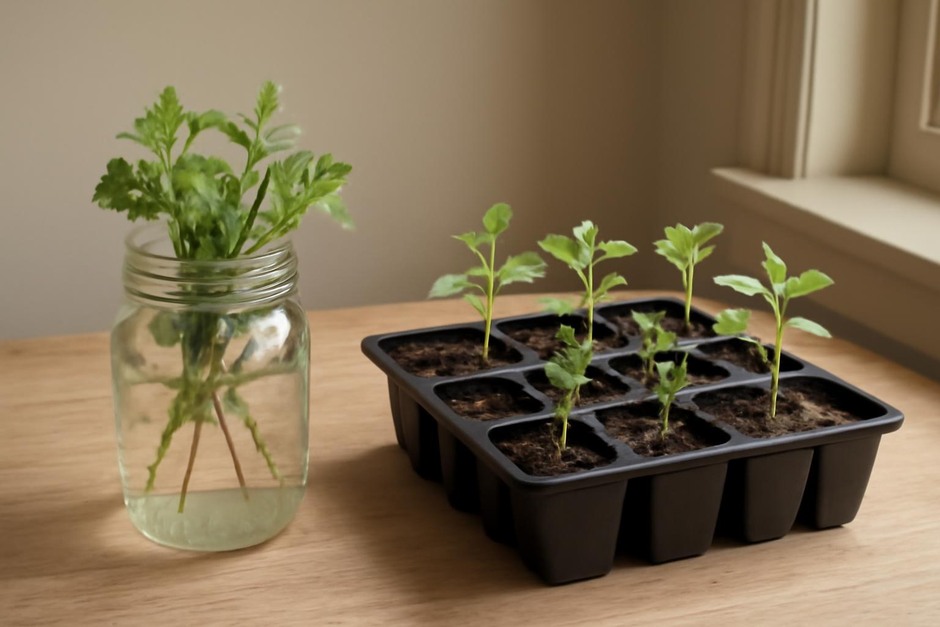
- Place three in clear water (mason jar) and three in small pots with standard potting mix, kept evenly moist.
- Keep both groups in the same light and temperature; change water every 3–4 days.
What to watch
- Time to first visible roots (days).
- Root length and robustness after 2–3 weeks.
- Survival after potting up water-rooted cuttings.
Trade-offs: water rooting is quick and visible—great for learning—but roots formed in water can be fine and require careful acclimation to soil. Soil rooting mimics final conditions and often yields sturdier roots but can be slower and harder to monitor.
Experiment 2 — With vs. Without Rooting Hormone (objective: measure hormone benefit)
Method
- Use eight matched cuttings in the same medium (choose potting mix from Experiment 1).
- Dip half of them in a commercial rooting powder or gel, and plant the other half untreated.
- Maintain identical watering and light conditions.
What to watch
- Rooting percentage after 2–4 weeks.
- Speed of root emergence and vigor.
Trade-offs: rooting hormones often increase success and speed, especially for woody herbs like rosemary. For very easy, soft-stem herbs (basil, mint), the difference may be small; cost and handling of hormones are the main drawbacks.
Experiment 3 — Media Comparison: Potting Mix vs. Perlite vs. Coco Coir (objective: learn how drainage and aeration affect roots)
Method
- Prepare three sets of three cuttings each, planting in (a) all-purpose potting mix, (b) pure perlite, and (c) coco coir or a coir-perlite mix.
- Keep moisture consistent: potting mix lightly moist, perlite damp but not saturated, coir evenly moist.
What to watch
- Rooting rate and presence of rot or mold.
- Ease of transplantation and root system structure.
Trade-offs: potting mix holds water and nutrients, reducing stress but risking rot in poor drainage. Perlite and coir offer excellent aeration and lower rot risk, and roots often look more fibrous; they may require more frequent watering and later nutrient feeding.
Experiment 4 — Humidity Dome vs. Open Air (objective: test humidity effects and need for acclimation)
Method
- Place matched cuttings in the same medium; cover half with a clear plastic dome or cut plastic bottle to raise humidity, leave the other half uncovered.
- Ventilate the dome briefly once a day to reduce fungal risk.
What to watch
- Leaf turgor (wilting vs. plump leaves) and onset of roots.
- Incidence of mold and timing for gradual acclimation (opening the dome).
Trade-offs: higher humidity prevents leaf water loss and often increases rooting success, especially for soft-stem herbs. However, it can promote fungal growth; managing airflow and stepping down humidity over a week avoids shock when moving plants to drier conditions.
How to interpret results and next steps
Record dates, root observations, and survival rates. Look for consistent patterns: if water rooting shows the fastest roots but plants struggle after potting up, prioritize soil methods for long-term success. If hormone-treated woody cuttings root reliably compared with untreated ones, consider using hormone for those species. Match your home conditions: if you tend to overwater, choose airy media like perlite mixes; if you forget to water, a moisture-retentive potting mix may be kinder.
Once you’ve run these small experiments, try scaling a favored method to 10–20 cuttings and practicing acclimation (gradually reduce humidity, shorten time in water if used, and feed lightly after roots form). Each small, controlled trial builds observation skills that turn sporadic success into a repeatable workflow for producing herbs from cuttings.
Keep notes, and repeat experiments in different seasons—temperature and light change outcomes. With these four experiments you’ll gain practical, comparative knowledge about materials and methods, plus an adaptable protocol you can use for the herbs you grow most often.